If there is one day in a lifetime that sharply divides your existence into a “before” and an “after”, it is the day you step into an operating room to have your brain operated on while wide awake.
The Preparation and the Walk
After a night in the neurosurgery ward, I was woken up at 6:00 AM by two nurses. The protocol began: a thorough shower, chlorhexidine mouthwash, compression stockings, head cap, hospital gown, standard medications, and a dose of 5-ALA, a fluorescent liquid that helps the surgeon visualize tumor tissue under special lighting.
Around 7:00 AM, I met my wife and parents. Because of the 5-ALA, I had to wear a blindfold to protect my eyes from light. I felt scared, but I tried to smile and give them the best version of myself, knowing this could be our last conversation. Riding the elevator toward the surgical suite, I felt my hand being squeezed through the bedsheets by my wife, my mom, and my dad.
I don't know whose hand I touched last before a heavy sense of void took over. Although I am a man of science, I prayed to God to bring me back alive to see my wife, my family, my brother (who was landing in Barcelona right at that moment), my grandma, my friends, and my colleagues.
The Spaceship Room
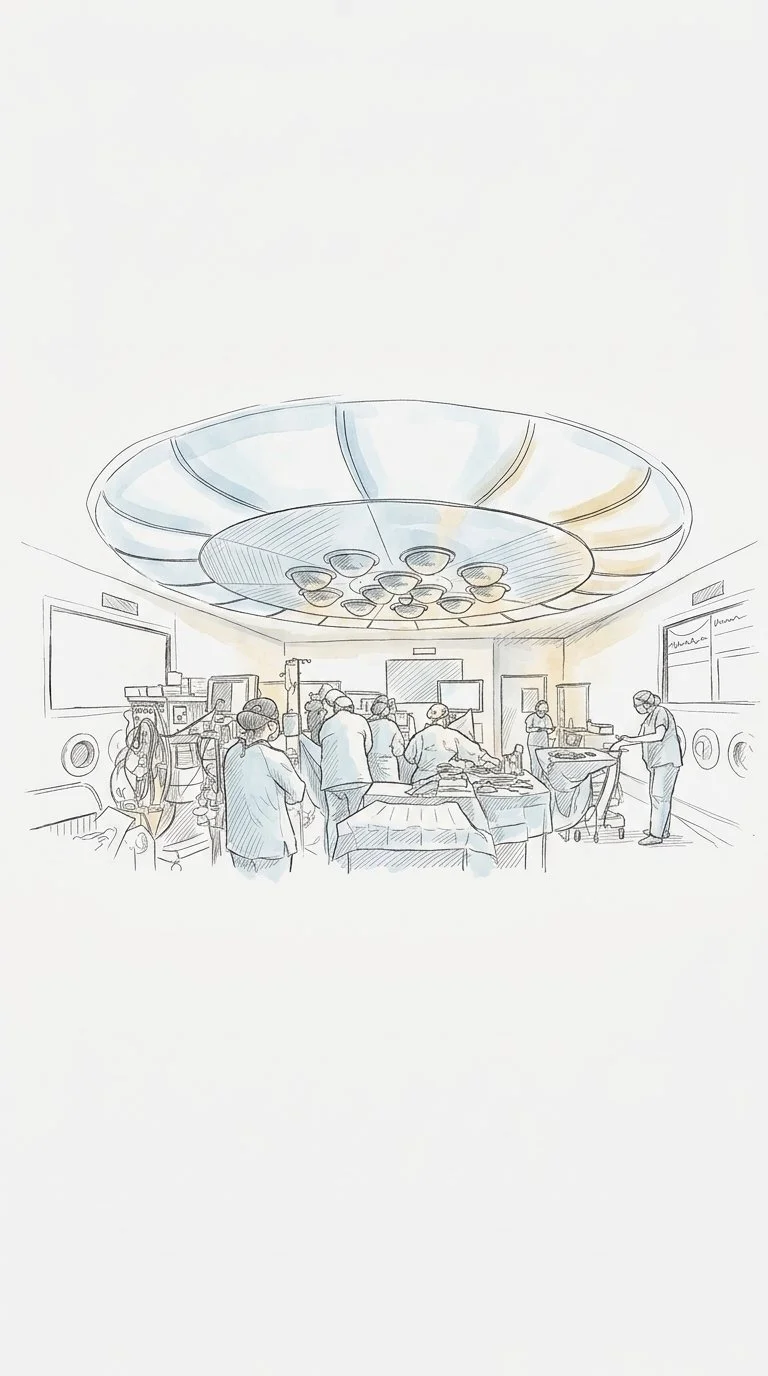
Inside the operating room, the lights were dimmed low and the atmosphere was quiet. The ceiling looked like a spaceship, dominated by a massive ring of lights and surrounding equipment.
The team moved with calm precision. The anesthesiologist, a young and smiling doctor, inserted lines into both my arms alongside her assistant to monitor vital signs and deliver medications. Next, a neurophysiologist attached sensors to my head, neck, and body to track brain activity in real time, monitoring limb movements and watching for intraoperative seizures that would require switching to general anaesthesia.
After several routine check steps, I was sedated briefly before waking up for the main event.
"It's Show Time!". Stepping into Version 2.0
When I opened my eyes, the room temperature had dropped significantly. Both the anesthesiologist and Silvia, the neuropsychologist, were standing before me in warm clothes. Silvia had her laptop open, ready for the cognitive tests.
The anesthesiologist checked on me, offering ice cubes for my dry lips and reminding me we could stop at any time if needed. My neck and dislocated left shoulder were aching severely, as my head was rigidly clamped in place while my body rested awkwardly on the injured shoulder.
Barely a minute later, brain mapping began. The surgeon, orchestrating movements directly from my exposed brain, used a probe delivering tiny electrical pulses to temporarily inhibit specific pathways and map critical boundaries. Beside me, Silvia ran a slide deck of common objects and verbs.
Right before starting, a thought flashed clearly in my mind: It’s show time. This was the defining moment to shape Version 2.0 of myself.
For the next 35 minutes, we went through roughly 1,000 visual stimuli, naming objects and actions across Italian, English, Spanish, and Catalan. A bed was the first image. At times, words in one language would briefly fail to surface as the probe touched a specific area, temporarily blocking the pathway before coming back. I pushed myself, attempting to name the same object in multiple idioms when it reappeared. Through the noise of the room and the subtle suction sound near my head, we mapped continuously until the task was successfully completed.
When asked if I wanted to stay awake for the rest of the procedure, I replied, "Fine by me!" Though I suspect I was sedated shortly after, as my last memory is simply the distinct sound of a drill tightening titanium screws into my skull.
To the entire medical team who stood by me that morning, ensuring every step went smoothly: I will be forever grateful for your skill and humanity. You gave me the chance to keep pedaling.
See you in the next post.